


The project ‘CUPOLA — Carbon-neutral pathways of recycling marine plastic waste’ has received funding from the European Union’s Horizon 2020 research and innovation programme under the Marie Skłodowska-Curie Actions (HORIZON-MSCA-2021-SE-01), grant agreement No 101086071.
Abstract of CUPOLA
Plastic pollution has become a persistent, transboundary pressure on aquatic ecosystems and a growing concern for human and animal health. An estimated 19–23 million tonnes of plastic waste enter lakes, rivers and seas each year, while continued production and short product lifetimes increase the stock of material available for leakage. Once released, plastics are transported across catchments and coastlines, accumulate in sediments and biota, and fragment into micro- and nanoplastics rather than fully biodegrading. The resulting pollution cannot be understood only as a waste-management failure; it is a coupled environmental, biodiversity, food-system, public-health and socioeconomic challenge.
Marine animals are affected by entanglement, ingestion, physical injury, impaired feeding, and altered reproduction, while plastic debris can modify habitats and transport organisms and their associated contaminants. Fragmentation expands the number of particles available to plankton, invertebrates, fish, seabirds and marine mammals, enabling transfer across trophic levels. These effects threaten ecosystem functions that support fisheries, coastal protection, tourism and food security. The burden is unevenly distributed, with coastal and island communities, informal waste workers and populations dependent on seafood and healthy marine resources facing disproportionate risks.
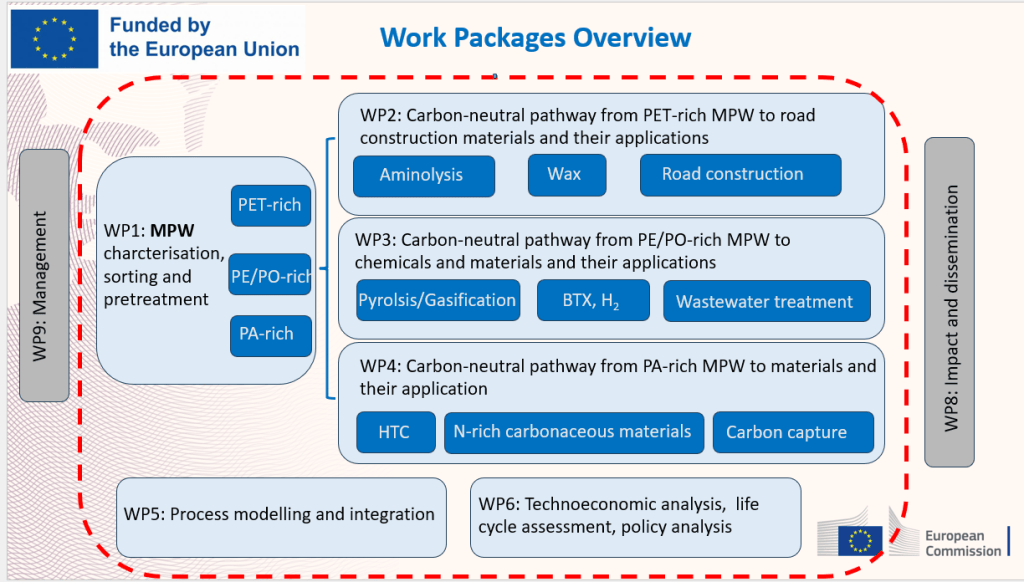
This project aims to develop sustainable, scalable, and profitable waste management processes for marine plastics. The automated plastic waste management and product innovation processes aim for environmental sustainability. Extensive training and knowledge exchange activities will be carried out among the world-leading scientist group. The scientists in this group share the common objective to develop the CUPOLA processes for marine plastic waste recycling. Thermal and thermochemical conversion technologies will be applied to produce high-value marketable products. Full process modelling, techno-economic and life cycle analysis will be carried out to provide vital information about the feasibility of the novel process.
CUPOLA will create a multi-disciplinary consortium consisting of process engineers, chemists, environmental scientists, and process modellers, and develop the innovative and economic waste-to-product process, closing the gap in the circular economy. It will produce multiple avenues for career development, cross-sectorial experience, and academic training in a multi-cultural, interdisciplinary and intersectoral environment, and lead to achieving SDGs 3, 12 and 14.

